Solved: PowerApps does not support "arrays" ? Power. . 10-20-2016 10:35 AM. PowerApps does not support "arrays", for GA or beyond, because it cannot encourage nor accomodate random access into data. The closest data structure in PowerApps would be a single-column table. Still, it's a table, just like SQL tables.
Solved: PowerApps does not support "arrays" ? Power. from agazoth.github.io
in my Flow-Process I want to pull some datafields from PowerApps and use it to populate a Word template (This works so far). Problem is that there can be up to 63 data fields.
Source: 1.bp.blogspot.com
To check all context variables in PowerApps click on File, then click on Variables. This displays all the screens present in the app. To check all context variables.
Source: 1.bp.blogspot.com
In some cases, you'll need to use variables in Power Apps, which extends Excel's model by adding behavior formulas. These formulas run when, for example, a user selects a.
Source: www.c-sharpcorner.com
As you can see Power Apps calls these Arrays tables or collections but whatever you call them they are list of objects or pieces of data. Get an item in an Collection or Table. In Flow you can now use array[0] to get.
Source: db-excel.com
PowerApps Pro Tips Using Variables. Like parameters, variables are very helpful, and can be used to increase user communication in your app. A variable in Microsoft.
Source: acomblogimages.blob.core.windows.net
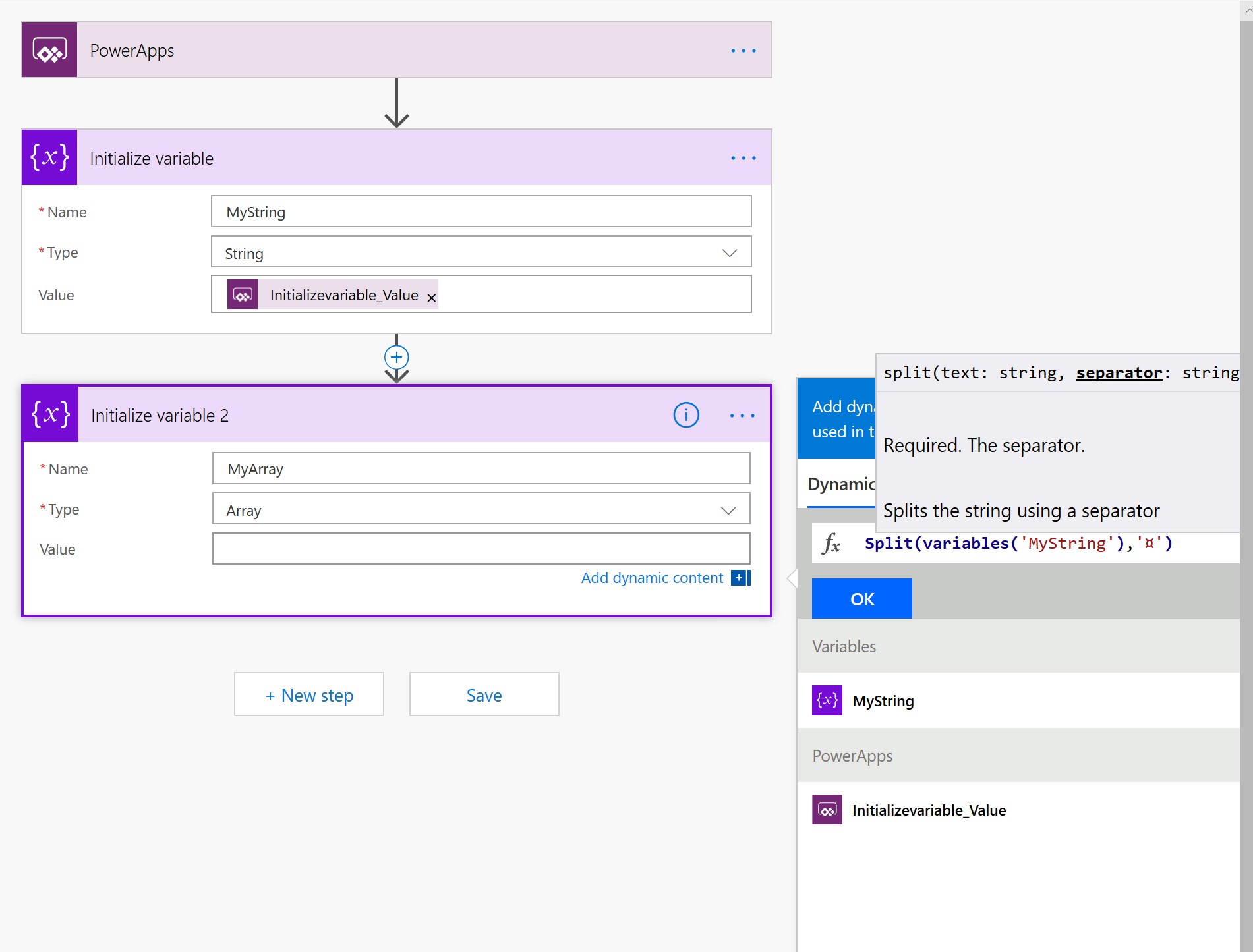
power automate apply to each item in array variable. Select the Initialize variable, and set the variable name, type as an array, and set the value like the below array..
Source: powerusers.microsoft.com
Description. The Table function creates a table from an argument list of records. The table's columns will be the union of all the properties from all the argument records. A.
Source: www.cleverworkarounds.com
The flow will be invoked from Canvas app. So it’s quite obvious that the flow trigger should be PowerApps. In the next step, I use the Initialize variable step. And guess what, I have an.
Source: powerusers.microsoft.com
Knowing how to return an array to PowerApps will make many more connectors useful to you. The existing "Execute a SQL query" action in Flow is now capable of sending its.
Source: agazoth.github.io
To view all variables used within your Power App and their values, you can go to File > Variables. From there, you can see both Global and Local variables. Global variables.
Source: powerusers.microsoft.com
Return an Array from Flow to PowerApps (Response Method) Brian Dang, Senior Program Manager, Microsoft Power Platform, Friday, May 4, 2018. Update 2018-06-06:.
Source: i.stack.imgur.com
PowerApps – Creating Indexed Arrays. Microsoft PowerApps does not currently support indexing in collections. There are some differences between true arrays (e.g. JavaScript) and PowerApps collections. Microsoft.
Source: baizini-it.com
Powerapps variables. A variable is a temporary storage that can be defined and used anywhere within Power Apps. Variables are created and typed by default when they are displayed in the.
Source: acomblogimages.blob.core.windows.net
Search for “ Initialize Variable ” action and select that. Give Name to your variable and select Type as Array. Use “List rows” action to retrieve the contacts from.
Source: www.cleverworkarounds.com
PowerApps: Concurrently returning variables and multiple arrays from Azure SQL Database; PowerApps: Repeating section with editing; PowerApps: How to update SharePoint choice and lookup type columns with.
0 komentar